
Selling an insurance agency is a significant business decision. Many agency owners have spent years building an insurance book of business, developing client relationships, securing carrier appointments, hiring producers, and creating dependable recurring revenue.
When the time comes to consider an insurance agency sale, having a clear exit strategy can make the process more organized and help you understand the options available. 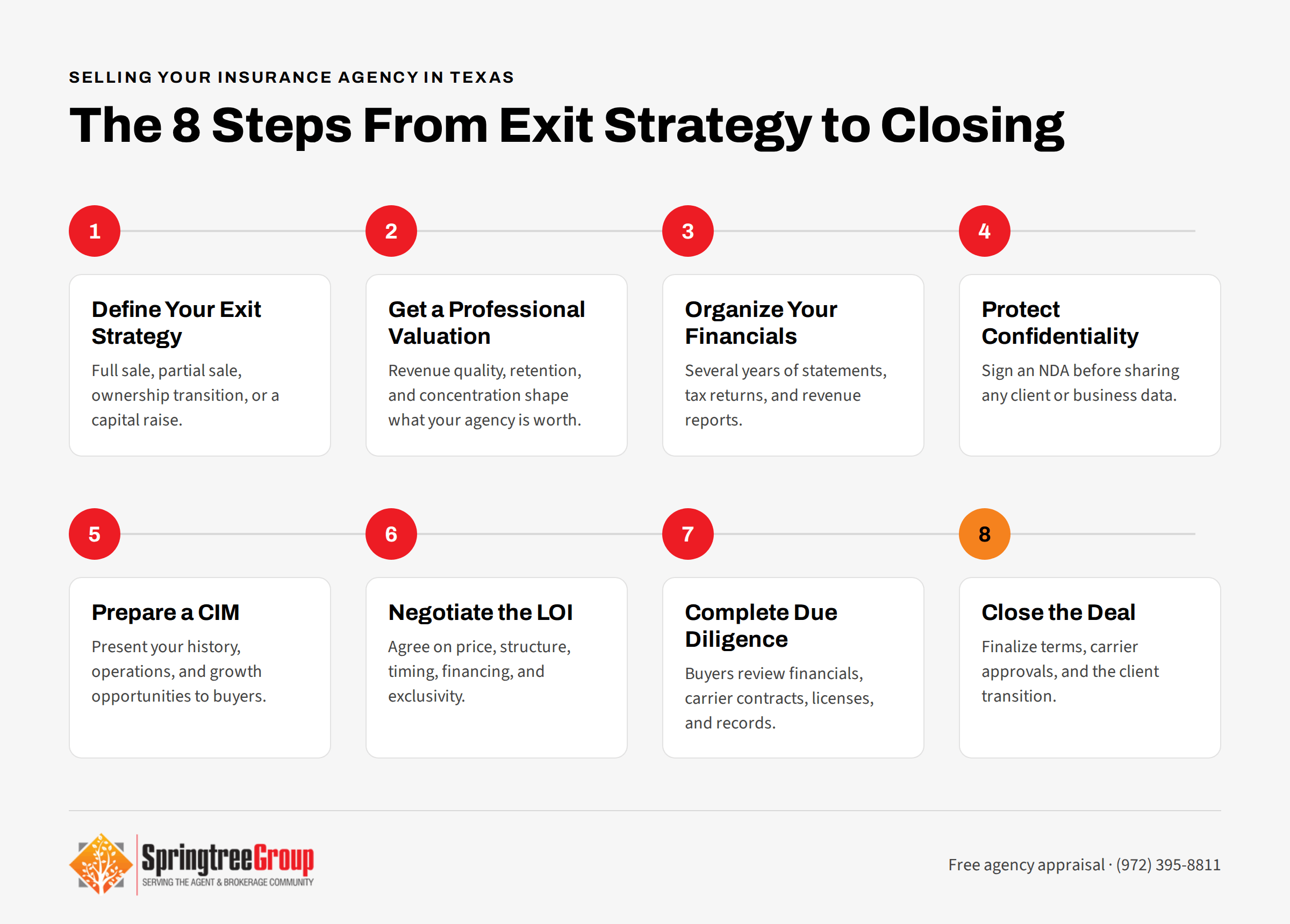
Start With Your Exit Strategy
Before putting an agency on the market, an owner should determine what they want from the transaction. An exit strategy may involve a complete sale, a partial transaction, a transition to another owner, or the raising of capital while retaining an ownership interest.
The right approach depends on factors such as the owner’s financial objectives, desired timeline, management structure, and willingness to remain involved after closing.
An independent insurance agency can have substantial value beyond its physical assets. Buyers may evaluate its renewal revenue, commission revenue, client relationships, carrier relationships, profitability, growth history, and future opportunities.
Understanding Agency Valuation
One of the first questions sellers often ask is, “What is my agency worth?” An agency valuation considers a range of financial and operational factors. Buyers may look at historical revenue, profitability, revenue composition, organic growth, retention, producer performance, and the sustainability of the agency’s cash flow.
The quality of an insurance book of business is particularly important. A book with stable clients, strong client retention, diversified revenue, and predictable renewals can be viewed differently from a book that relies heavily on a small number of accounts or producers.
Factors That Affect Your Agency’s Value:
· Recurring revenue and renewal revenue
· Commission revenue and historical profitability
· Carrier concentration
· Producer dependence
· Client retention and account longevity
· Commercial lines versus personal lines
· Carrier appointments
· Sub-agent relationships
· Geographic concentration
· Growth trends and operating expenses
There is no single formula that determines the value of every Texas agency. A professional valuation and transaction analysis by Springtree Group can provide a more useful picture of the agency’s potential market value and available transaction structures.

Prepare Your Financial Information
Potential buyers and financing sources will want to understand the agency’s financial performance and verify the information the seller provides. Owners should be prepared to organize several years of financial statements, tax returns, revenue reports, producer compensation information, and other supporting documentation.
A certified public accountant can help make sure financial information is properly organized and presented. Depending on the nature of the transaction, buyers may also carry out financial, legal, operational, and insurance-specific due diligence.
Protect Confidential Information
During the sale process, agency owners generally want to keep sensitive client and business information protected. For that reason, a nondisclosure agreement (NDA) is commonly put in place before any confidential information is shared with a prospective buyer.
Once appropriate confidentiality protections are in place, sellers may provide information about their operations, financial performance, clients, employees, producers, and carrier relationships.
A well-organized confidential information memorandum can also help present the business professionally. This document may summarize the agency’s history, operations, financial performance, market position, revenue composition, and opportunities for future growth.
Review Carrier Contracts and Appointments
Insurance agencies operate within a complex network of relationships with insurance carriers, wholesalers, MGAs, clients, producers, and other partners. As a result, sellers
should carefully review their carrier contracts and carrier appointments before entering into a transaction.
Before taking any next steps, a potential buyer may want to review the agency’s existing appointments to determine whether they can be transferred. It may also be necessary to determine whether carrier approval is required and whether a change of control triggers any specific contractual requirements.
Reviewing the agency’s license is also part of the transaction. Sellers can use TDI’s license lookup resources to verify applicable licensing information and ensure they properly account for Texas insurance licensing requirements.
Buyers may also verify that the agency license is active, properly maintained, and consistent with the entity and lines of insurance being transferred.
Evaluate the Structure of the Sale
Not every insurance agency sale is structured the same way. Two common approaches are an asset sale and an equity sale.
Asset Sale
In an asset sale, the buyer purchases specified assets of the agency, which can include certain client accounts, the insurance book of business, goodwill, and other business assets.
Equity Sale
In an equity sale, what the buyer acquires is ownership interests in the company itself. That can amount to the buyer assuming ownership of the existing entity, though this depends on the negotiated terms and any applicable contracts.
Seller Financing and Earn-Outs
Other transaction structures can include seller financing, an earn-out, or a combination of cash, financing, and future performance payments. For example, an earn-out may tie a portion of the purchase price to future revenue, retention, or another agreed-upon metric. Seller financing may allow the buyer to pay part of the purchase price over time.
Pay Attention to Client Retention
For an insurance agency, the value of the business is closely connected to its ability to retain clients and generate future renewal revenue. Buyers may therefore examine historical client retention, policy renewal patterns, account concentration, and relationship stability.
The composition of the agency also matters. A Texas agency specializing in commercial lines may have a different revenue profile and risk profile than an agency primarily focused on personal lines.
Similarly, an agency heavily dependent on a single producer or a small set of relationships may require a different transition plan than an agency with a diversified team and strong operating infrastructure.
Consider Your Customer Relationship Management Systems
Technology and operational systems can also affect the transaction. Buyers may review the agency’s customer relationship management system, agency management systems, accounting procedures, marketing processes, and documentation practices.
A clean and organized system can make it easier to demonstrate how clients are managed and how the agency generates and retains revenue.
Sellers should also identify important sub-agent relationships, producer agreements, employment arrangements, and other third-party relationships that could affect the transaction.
Letter of Intent and Due Diligence
Once a potential buyer has reviewed the opportunity, the parties may negotiate a letter of intent (LOI). The agreement generally outlines key business terms, including the proposed purchase price, transaction structure, timing, financing, exclusivity, and other major conditions.
The LOI is followed by more detailed due diligence.
During due diligence, the buyer may review financial statements, tax returns, carrier contracts, client information, producer agreements, licenses, organizational documents, technology systems, and other business records.
Preparing a data room early can be valuable for this reason. It gives the seller a chance to organize information ahead of any buyer request, and it may help identify potential issues before they delay closing.

How Springtree Group Can Help
Springtree Group is a private firm that finances, invests, acquires, sells, and consults in the insurance-related business services space. STG works nationally with agents, brokers, and insurance support companies, providing a broad range of financial products and M&A services.
Our product portfolio includes equity financing, asset-based financing, commission-based loans, SBA loans, and “Mash Up” M&A services. Through strategic partners, STG provides financial products and services developed specifically for the independent insurance agent and brokerage community.
If you are considering selling your independent insurance agency, exploring an acquisition, evaluating your agency’s valuation, or seeking financing to support your next stage, Springtree Group can help you assess the possibilities. Call us at (972) 395-8811 or contact us online.